 Admin
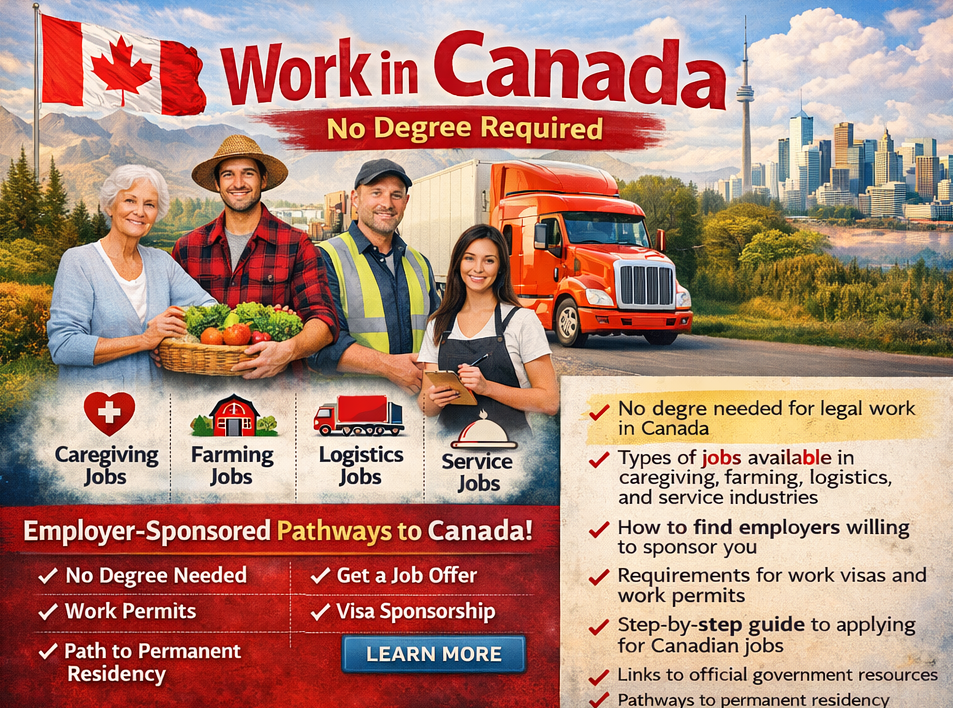
AdminCanada is facing one of the largest labor shortages in its history, particularly in essential sectors such as caregiving, agriculture, logistics, and service industries. To address this gap, the Canadian government allows employers to hire foreign workers without requiring a university degree, provided certain conditions are met.
For thousands of people around the world, this creates a real opportunity to work legally in Canada, earn in Canadian dollars, and in many cases transition to permanent residence (PR).
This comprehensive guide explains everything you need to know about employer-sponsored work pathways in Canada, especially for non-degree holders, including:
Why Canada Is Hiring Foreign Workers Without Degrees
Canada’s population is aging rapidly, and many Canadians are retiring faster than they can be replaced. At the same time:
As a result, Canada depends heavily on Temporary Foreign Workers (TFWs) and Permanent Immigration Pathways tied to employers.
The key system that enables this is the Temporary Foreign Worker Program (TFWP) and International Mobility Program (IMP).
Key Employer-Sponsored Work Programs in Canada
1. Temporary Foreign Worker Program (TFWP)
This is the main pathway for low-skill and semi-skilled jobs.
Employers must:
Foreign workers then use the LMIA to apply for a Canadian work permit.
Official link:
https://www.canada.ca/en/employment-social-development/services/foreign-workers.html
2. International Mobility Program (IMP)
Some jobs are LMIA-exempt due to:
This pathway is less common for low-skill jobs but still relevant in some caregiving and service roles.
Official link:
https://www.canada.ca/en/immigration-refugees-citizenship/services/work-canada/permit/temporary.html
Sector 1: Caregiving Jobs in Canada (No Degree Required)
Caregiving is one of the fastest and most reliable pathways to Canada.
Common Caregiving Jobs
Why Caregivers Are in High Demand
Caregiver Work Programs
Home Child Care Provider Pilot
Home Support Worker Pilot
These programs allow caregivers to:
Official link:
https://www.canada.ca/en/immigration-refugees-citizenship/services/immigrate-canada/caregivers
Caregiver Job Requirements
Salary Range
Sector 2: Farming & Agricultural Jobs
Canada’s agricultural sector relies heavily on foreign workers.
Common Farming Jobs
These jobs are seasonal or year-round and do not require degrees.
Seasonal Agricultural Worker Program (SAWP)
SAWP allows workers from eligible countries to work in Canada for up to 8 months.
Official link:
https://www.canada.ca/en/employment-social-development/services/foreign-workers/agricultural
Agricultural Stream (TFWP)
Employers can hire foreign workers for:
Requirements
Salary
Sector 3: Logistics & Transportation Jobs
Canada’s supply chain depends on logistics workers.
Common Logistics Jobs
Truck Driving: A High-Demand Role
Truck drivers are among the most in-demand workers in Canada.
Requirements:
Official link:
https://www.jobbank.gc.ca/trend-analysis/search-occupational
Salary Range
Sector 4: Service & Hospitality Jobs
Service jobs are abundant across Canada.
Common Jobs
Why Service Jobs Are Ideal for Newcomers
Requirements
Salary
Step-by-Step: How to Get an Employer-Sponsored Job in Canada
Step 1: Identify Eligible Jobs
Search only for employers willing to sponsor foreign workers.
Recommended platforms:
https://www.workopolis.com
Filter keywords:
Step 2: Secure a Job Offer
The employer must:
Step 3: Employer Applies for LMIA
LMIA proves hiring you won’t harm Canadian workers.
Processing time:
Step 4: Apply for Work Permit
Once LMIA is approved, you apply online.
Work permit application link:
https://www.canada.ca/en/immigration-refugees-citizenship/services/work-canada/permit.html
Step 5: Medical & Biometrics
Step 6: Travel to Canada & Start Work
Required Documents Checklist
Can These Jobs Lead to Permanent Residence?
Yes. Many employer-sponsored jobs lead to PR through:
1. Canadian Experience Class (CEC)
https://www.canada.ca/en/immigration-refugees-citizenship/services/immigrate-canada/express-entry/eligibility/cec.html
2. Provincial Nominee Programs (PNP)
3. Caregiver PR Pathways
https://www.canada.ca/en/immigration-refugees-citizenship/services/immigrate-canada/caregivers.html
Common Scams to Avoid
Canada does not charge for job offers.
Final Thoughts
Canada’s employer-sponsored work pathways offer real, legal opportunities for people without university degrees to:
Caregiving, farming, logistics, and service jobs are not “low-value” roles — they are essential to Canada’s economy and increasingly respected pathways to permanent residency.
If you take the right steps, verify employers, and apply through official channels, Canada is genuinely achievable.


 Admin
Admin